


Every Thursday I send a short rate update to the people I’ve worked with over the years. This week’s went out with a headline I don’t use lightly: a quick rate check could save you $50 or more a month. Rates moved again, and the move was big enough that it’s worth walking through what happened and what it means if you own a home anywhere in Broward or Palm Beach.
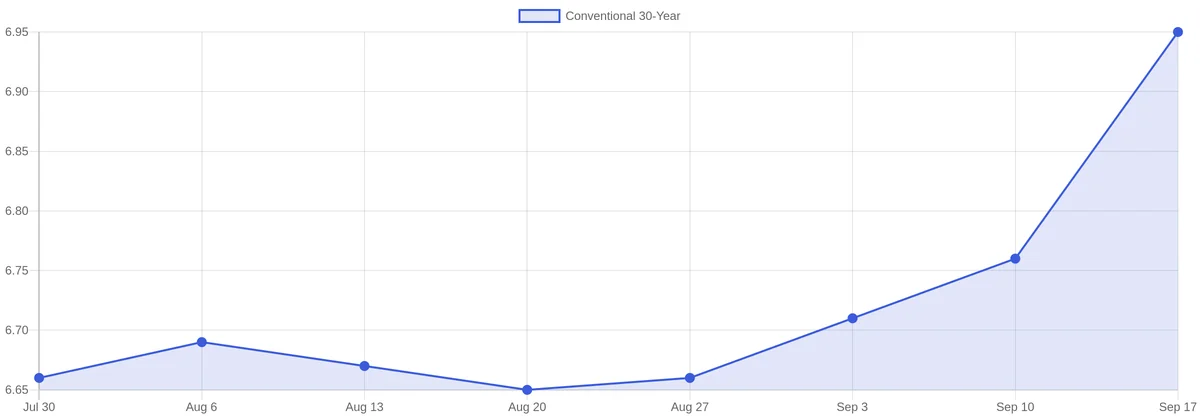
Here’s the snapshot that went out on September 17, exactly as my clients saw it.
Rates shown are national averages, provided for information only. Actual rates vary with credit profile, loan amount, property type and market conditions. Contact me for a personalized quote.
What this week’s rate movement means for your payment
Look at the right side of that chart. The 30-year conventional average sat between 6.65% and 6.71% for most of August, then climbed three weeks in a row and finished at 6.95%, the top of its 30-day range. That’s roughly three-tenths of a point in three weeks, which in mortgage terms is a real move.
Mortgage rates shift a little almost every week, and small shifts add up to real dollars. On a typical loan, even a quarter-point change can mean $50 or more a month, money that’s better in your pocket than anyone else’s. Stretch that over the five to seven years most people actually keep a mortgage and a quarter point is several thousand dollars.
Two things stand out in this week’s numbers for South Florida homeowners specifically:
- The 15-year is sitting well under the 30-year. At 6.26% versus 6.95%, that spread is wide by recent standards. If you’ve built equity and your income can carry a higher payment, a 15-year refinance is worth pricing, because you buy a lower rate and cut years off the term in the same move.
- VA and FHA are both under conventional. Veterans and FHA borrowers who assume conventional is automatically cheaper should get both priced. In weeks like this one, the government programs often win outright.
Should I refinance my mortgage right now?
The honest answer is “it depends on when you closed and what you’re paying,” so here is how I sort it.
If you closed in late 2023 or 2024, there’s a good chance you locked in the high sevens or above. Even after this week’s rise, today’s averages are meaningfully below that, and for many of those files a refinance pays for itself quickly. This is the group I’m calling first.
If you closed in 2025 or early 2026, you’re probably close to where the market is now, and a straight rate-and-term refinance won’t move the needle this week. That can change fast, which is the whole point of being ready (more on that below). A cash-out or a HELOC may still make sense if you’re carrying higher-rate debt elsewhere.
If you closed before 2022, you’re likely holding a rate that nobody will beat for a long time. Don’t touch it. If you need cash from the house, a HELOC or second lien preserves that first-mortgage rate.
The math that settles it is break-even: total cost of the refinance divided by the monthly saving equals the months until it has paid for itself. If you’ll be in the house longer than that, the refinance works. If you won’t, it doesn’t, no matter how good the new rate sounds. I covered exactly what goes into that cost in closing costs in South Florida, and a lot of it can be structured as a lender credit so you bring nothing to the table.
When to refinance: be ready instead of trying to time it
You don’t have to time the market perfectly. Nobody does, including the people who talk about it on television. What matters most is being ready, so that when a window opens we can move in a day instead of three weeks:
- Know your current rate, balance and remaining term. Pull your latest statement. That’s the whole input.
- Get your credit in shape now. Pay balances under 30% of their limits, don’t open new accounts, and fix anything wrong on the report before you need it.
- Keep your documents handy. Two years of returns, recent pay stubs or bank statements, and a mortgage statement. Self-employed borrowers, we’ll talk about bank-statement options instead of returns.
- Set a target. Tell me the rate that makes it worth doing and I’ll watch for it. When it prints, we lock.
If you bought or refinanced in the last couple of years, it’s worth a five-minute check to see whether today’s rates could lower your payment. There’s no obligation and no cost to run the numbers, and no credit pull for the conversation. Just clarity on where you stand.
Tip of the week
Replace the weatherstripping around exterior doors every few years. It’s one of the cheapest ways to improve energy efficiency, and in a South Florida summer a leaky door is money going straight out to the driveway.
Tips for homeowners: a zero-down option for rural buyers
One from the mailbag this week. A reader asked whether zero-down financing still exists outside of VA. It does, through the USDA guaranteed program, and it reaches closer to town than most people expect. The three things to know:
- It’s 100% financing for eligible properties in USDA-designated rural and suburban areas. The eligibility map includes areas nearer to cities than you’d guess, including pockets of western Palm Beach and the outer edges of Broward.
- There are income limits, typically 115% of the area median income. Both the property location and the household income have to qualify.
- There’s an upfront guarantee fee of 1% of the loan and an annual fee of 0.35% of the balance. Both are lower than FHA’s mortgage insurance and can be rolled into the loan.
Let’s run the numbers together
Want to see what today’s rates mean for your payment? Send me your current rate and balance and I’ll tell you in one call whether a refinance is worth doing this week, worth waiting on, or worth leaving alone. Start with the two-minute form or reach out directly, and if you’re a client from years back, you know the number.
Have questions about how any of this affects your mortgage or a purchase you’re planning? Reach out any time and we’ll walk through your options.