


Every Thursday I send a short rate update to the people I’ve worked with over the years. This week’s had two jobs. The first was rates, which climbed for most of the last two months and finally took a breath. The second was taxes: we’re ten weeks from December 31, and a couple of mortgage moves you make before then show up on the return you file in April.
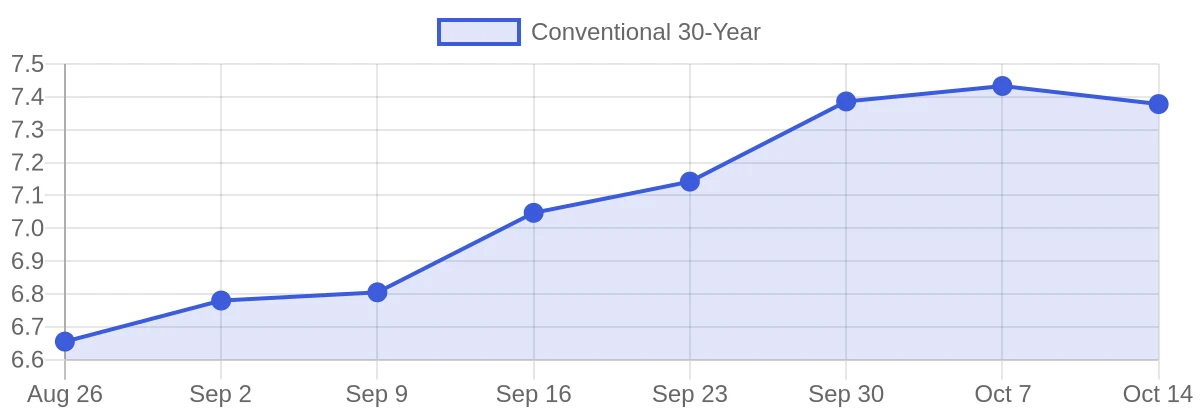
Here’s the snapshot that went out on October 15, exactly as my clients saw it.
Rates shown are national index rates, provided for information only. Actual rates vary with credit profile, loan amount, property type and market conditions. Contact me for a personalized quote.
The short version: the mortgage interest deduction is alive and its $750,000 limit is now permanent, but it only pays if you itemize past the 2026 standard deduction of $32,200 for married couples ($16,100 single). A Broward borrower with a $400,000 loan at today’s rates pays about $29,400 in interest in the first year, which together with property taxes clears that bar. Meanwhile, the 30-year average finally stopped climbing: 7.38%, down from a 7.43% peak a week earlier.
What this week’s rate movement means for your payment
Look at the right side of that chart. The 30-year average went from 6.66% at the end of August to 7.43% on October 7, six straight weeks of increases and more than three-quarters of a point in total. This week it ticked down for the first time since August. One week is not a trend, but it’s the first breather in a while.
Mortgage rates move a little almost every week, and small moves add up to real dollars. Here’s what a single quarter point does at today’s level on a 30-year fixed:
That’s the “$50 or more a month” from the newsletter, made specific: at a Broward-sized balance a quarter point is $68 to $85 a month, and over the five to seven years most people actually keep a mortgage it’s four or five thousand dollars.
You don’t have to time the market perfectly. Nobody does. What matters is being ready: credit in good shape, documents handy, and a target rate you’ve already told me about, so that when a window opens we lock in a day instead of scrambling for three weeks. If you bought or refinanced in the last couple of years, a five-minute check on a mortgage refinance in Broward tells you where you stand. No obligation, no cost, no credit pull for the conversation.
Is mortgage interest tax deductible in 2026?
Yes, and the rules got more settled this year, not less. The 2025 federal tax law made the $750,000 acquisition-debt limit permanent, so interest on up to $750,000 of mortgage debt on your main home and one second home is deductible. Loans from before December 16, 2017 keep the old $1 million limit.
The deduction itself was never the hard part. The hard part is that it only counts if you itemize, and the standard deduction is big:
Here’s how that plays out on a real-sized file. Take a married couple in Broward who bought this year with a $400,000 loan at 7.38% and pay, say, $8,000 a year in property taxes:
- First-year mortgage interest: about $29,400. Early in a loan almost all of the payment is interest.
- Property taxes: $8,000. Florida has no state income tax, so for most Broward homeowners this is the whole state-and-local line, well under the $40,400 cap.
- Total itemized: about $37,400, versus a $32,200 standard deduction. Itemizing wins by roughly $5,200, and every dollar of charitable giving adds to the margin.
Run the same numbers on a $250,000 loan from 2021 at 3% and the interest is closer to $6,500. That household takes the standard deduction and the mortgage interest deduction does nothing for them, which is fine, because they have a 3% mortgage. Single filers clear the bar much more easily at $16,100.
Year-end tax moves for homeowners
These are the three from the newsletter, with the numbers filled in. Talk to your tax preparer before acting on any of them. I’m your mortgage guy, not your CPA.
1. Make your January payment in December
Mortgage interest is paid in arrears. The payment due January 1 covers December’s interest, so if your servicer receives it by December 31, that interest lands on this year’s Form 1098. On a $400,000 loan at 7.38%, that’s about $2,460 of interest pulled into this tax year. At a 22% bracket that’s roughly $540 back, provided you’re itemizing this year.
Be honest about what this is: a timing move. Next year’s 1098 will show eleven months of interest instead of twelve. It makes the most sense in a year you itemize and expect higher income than next year, or a year you’re right at the edge of the standard deduction and the extra month pushes you over. Pay early enough that it posts in December. A payment mailed December 30 that arrives January 3 does nothing.
2. PMI is deductible again starting in 2026
This one wasn’t in the newsletter, and it matters to a lot of recent buyers. Starting with the 2026 tax year, mortgage insurance premiums are treated as deductible mortgage interest again, after lapsing for 2022 through 2025. That covers conventional PMI, FHA mortgage insurance, the VA funding fee and the USDA guarantee fee on your home.
The limit is income. The deduction starts shrinking once adjusted gross income passes $100,000 ($50,000 married filing separately) and is gone a little under $110,000. Under that line, a $150-a-month PMI bill is $1,800 a year of deductions that weren’t there last year. If you put less than 20% down, ask your preparer about this one specifically. Better still, check whether you can drop it entirely; my mortgage statement check for Broward homeowners walks through when PMI comes off. A deduction on a bill you no longer pay beats a deduction on one you do.
3. Document your improvements now
If you plan to sell next year, gather the receipts for every improvement you’ve made: a new roof, impact windows, a kitchen, a pool, hurricane shutters. Improvements add to your cost basis, and a higher basis means a smaller taxable gain when you sell.
Most people assume the home-sale exclusion covers them. It covers a lot: $250,000 of gain for a single owner and $500,000 for a married couple who’ve owned and lived in the home for two of the last five years. But a Broward homeowner who bought in 2012 and sells now can have a gain well past that, and a $40,000 roof plus $25,000 of impact windows can be the difference between owing tax and not. Repairs don’t count. Improvements do. Your receipts are the proof.
Bonus: check your W-4 if you bought this year
If you bought a home in 2026 and expect to itemize, your employer may be withholding as if you won’t. Updating your W-4 puts that money in your paycheck now instead of in a refund next spring. Most payroll systems let you change it in five minutes.
Tip of the week: run a credit simulator before you pay anything down
Before you start paying off balances to qualify for a better rate, ask your loan officer to run a credit simulator. It shows exactly which action moves your score the most: paying one card under 30% of its limit, paying another to zero, or leaving a third alone. The difference can be twenty points for the same dollars. If the change pushes you into a better pricing tier, a rapid rescore can get the new score on your file in days instead of waiting a month for the bureaus to catch up. It’s part of how I work every Broward home loan pre-approval.
Before December 31: the short list
Let’s run the numbers together
Want to see what today’s rates mean for your payment, or whether a refinance is worth doing this year, next year or not at all? Send me your current rate and balance and I’ll tell you in one call. Start with the two-minute pre-approval form, or reach out directly. If you’re a client from years back, you know the number.
Have questions about how any of this affects your mortgage or a purchase you’re planning? Reach out any time and we’ll walk through your options.