


Most people pay their mortgage on autopay and never open the statement. I get it. But that one page carries more useful information than almost anything else you get in the mail, and a two-minute look can save you real money. It can catch mortgage insurance you no longer owe, warn you about a payment increase before it lands, and tell you whether a refinance is worth a phone call.
This was the lead story in my October 1 update to clients. Here’s the expanded version, plus where rates closed out September.
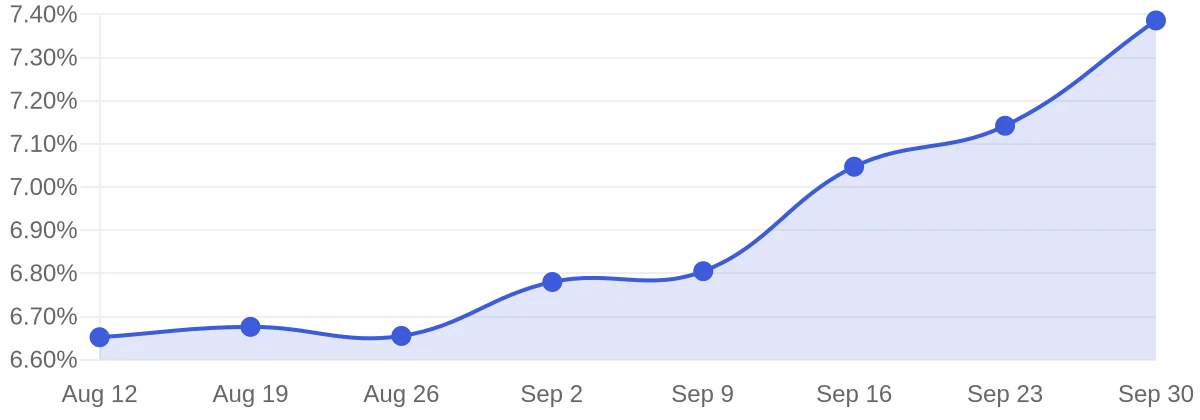
Rates shown are national averages, provided for information only. Actual rates vary with credit profile, loan amount, property type and market conditions. Contact me for a personalized quote.
Rates kept climbing through September. The 30-year conventional average finished the month at 7.39%, the top of its 30-day range and about three-quarters of a point above where it sat in mid-August. That makes the statement check below more useful, not less. When rates are up, the money you save usually comes from your existing loan, not a new one.
1. Your escrow balance: the reason your payment changes
If you have a fixed-rate loan, your principal and interest never change. So when someone tells me “my mortgage payment went up,” the answer is almost always escrow.
Your servicer collects your property taxes and homeowners insurance as part of each payment, holds the money in an escrow account, and pays the bills when they come due. Once a year it runs an escrow analysis: it looks at what it actually paid out, projects the next 12 months, and resets your monthly amount. It’s also allowed to hold a cushion of up to two months of escrow payments.
If taxes or insurance went up, two things happen at once:
- Your monthly escrow amount rises to cover the higher bills going forward.
- You may have a shortage for the year that just ended, because the account collected at the old, lower amount. You can usually pay the shortage in one lump sum or spread it over the next 12 months.
Here’s how that plays out when a homeowners insurance renewal jumps by $1,800 a year:
Two things make escrow surprises especially common for South Florida homeowners:
- Property taxes reset after you buy. Homestead caps limit how fast a long-time owner’s assessed value can rise, so the seller’s tax bill is often far lower than yours will be. Your first escrow is set from that lower bill. The year after you close, the property appraiser reassesses at market value, your taxes jump, and so does your escrow. File for your own homestead exemption right away so the reset is as small as possible.
- Insurance premiums move a lot. Wind and flood coverage here can change sharply at renewal, and the escrow analysis is where you feel it.
What to check: compare the tax and insurance amounts on your escrow analysis to your actual tax bill and your policy’s declarations page. Servicers do make mistakes, like paying an old policy or missing a homestead exemption. If the numbers are right and insurance is what jumped, shop the policy before the next renewal. If the analysis shows a surplus of $50 or more, the servicer generally has to refund it to you.
2. Your principal balance: PMI you may not need anymore
If you put less than 20% down on a conventional loan, you’re probably paying private mortgage insurance (PMI). It protects the lender, not you, and it doesn’t have to last forever. Your statement shows your current principal balance, so it’s the fastest way to see how close you are to dropping it.
How to get rid of PMI on a conventional loan:
- Ask for it at 80%. Once your balance reaches 80% of the home’s original value, on schedule or because you paid extra, you can ask your servicer in writing to cancel PMI. You need to be current with a good payment history, and the servicer can ask for proof the value hasn’t dropped.
- It drops automatically at 78%. If you never ask, PMI has to come off when your balance is scheduled to hit 78% of the original value, as long as you’re current.
- Use today’s value, not the purchase price. Here’s the one most people miss. If your home has gone up in value, many loans let you remove PMI based on a new appraisal. The usual thresholds are 75% loan-to-value if you’ve had the loan two to five years, and 80% after five. A renovation that added value can qualify sooner.
How long that takes on schedule depends mostly on your down payment:
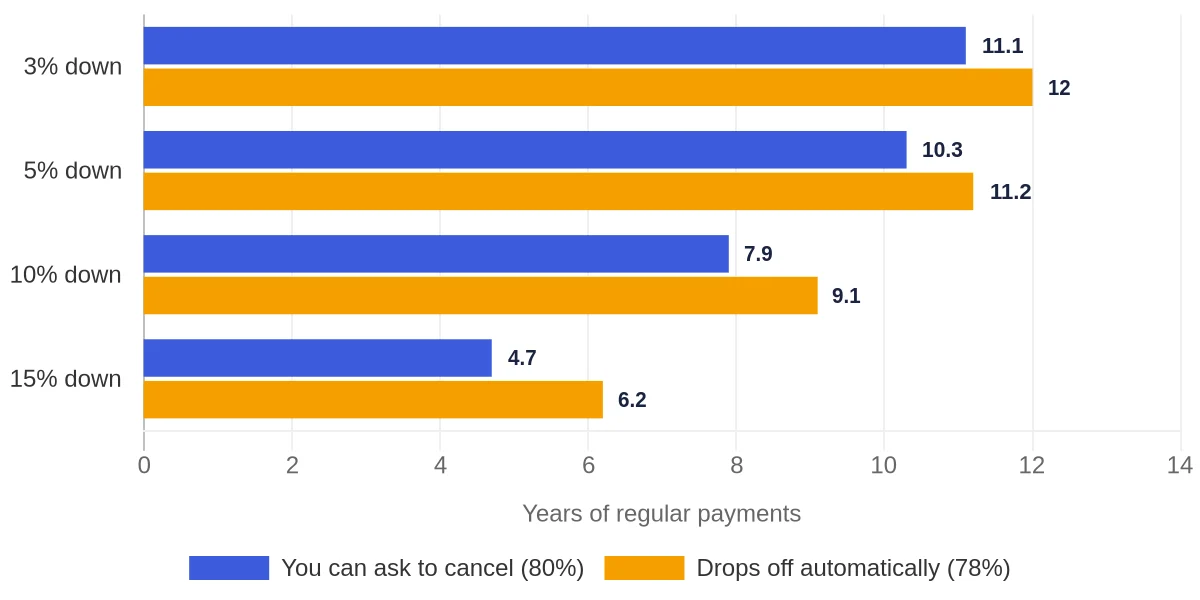
That chart is the slow way. If you bought three or four years ago, there’s a decent chance your home is worth more than you paid, and the appraisal route can take years off it. A $500 appraisal that removes a $150 monthly PMI payment pays for itself in under four months. And while you are still paying it, starting with the 2026 tax year PMI counts toward the mortgage interest deduction again for households under about $110,000 of income.
If you have an FHA loan, the rules are different. For FHA loans from June 2013 on, mortgage insurance lasts 11 years if you put 10% or more down, and for the life of the loan if you put down less. For most FHA borrowers, the only way out is refinancing into a conventional loan once you have enough equity. With rates where they are, that only makes sense if the PMI savings outweigh any rate difference, and that’s exactly the math I’ll run for you. VA loans have no monthly mortgage insurance at all.
3. Your interest rate and loan type: is a refinance worth a call?
Your statement lists your interest rate, and usually your loan type. Write both down. You need them to know whether a refinance could help, and plenty of people genuinely don’t remember.
- If you have an adjustable-rate loan, find out when it next adjusts and what the cap is. An adjustment date sneaking up in a 7% market is something to plan for, not discover.
- If your rate is above today’s averages, a refinance might lower your payment, but only if you’ll keep the loan long enough to recover the closing costs. Divide the total cost of the refinance by the monthly savings and you get the months to break even. I walk through what goes into that cost in closing costs in South Florida.
- If your rate is well below today’s market, don’t touch it. If you need cash from the house, a HELOC lets you borrow against your equity without giving up that first-mortgage rate.
- If you’re on FHA and paying mortgage insurance, look at the rate and the insurance together, as covered above.
Two more lines worth a glance
Once you’ve checked the big three, these take ten more seconds:
- Your servicer’s name. Loans get sold, and the company you pay can change. If you get a transfer notice, update your autopay right away. There’s a 60-day grace period where a payment sent to the old servicer can’t be treated as late, but it’s easier not to need it.
- Any “unapplied” or “suspense” funds. If a payment came in short or odd, servicers can park it in a suspense account instead of applying it. Money sitting there isn’t reducing your balance. If you see it, call and ask why.
Tip of the week
If the payment fits your budget, look at a 15-year mortgage. The rate is lower (6.62% versus 7.39% on September 30), and paying the loan off in half the time means paying far less in total interest.
Tips for homeowners: how lenders verify your income
Whether you’re refinancing or buying your next place, this is what an underwriter looks at:
- W-2 employees typically provide two years of W-2s and 30 days of pay stubs. Steady base salary usually counts at its current figure, but if your pay jumped recently or changed structure, expect the lender to look harder at how it compares to your history.
- Bonus, overtime and commission income usually needs a two-year history to count, and lenders average it over that period. If it’s new, most lenders won’t include it in your qualifying income yet.
- Bank statements are reviewed for large deposits. Anything unusual has to be explained and sourced, because lenders are required to document where your funds come from. If you’re self-employed, a bank statement loan can qualify you on deposits instead of tax returns.
Send me your statement
Not sure what your statement is telling you? Send it over and I’ll break it down. I’ll tell you whether your PMI can come off, whether your escrow numbers look right, and whether a refinance is worth doing now, worth watching, or worth leaving alone. Start with the two-minute form or reach out directly. There’s no cost and no credit pull for the conversation.